What practice teaches, beyond the studies
Scientific publications describe averages, in selected patients. A patient about to have surgery wants to know what happens in practice: how long before going back to work, when the symptoms go away, what can go wrong. The observatories answer these questions from a surgeon's experience.
Figures from real practice
The results presented are those of patients operated on by Dr Teboul, not averages taken from the literature.
An expert view, signed
Each observatory brings together the insights of a hand surgeon after 30 years of practice, attached to his name and dated.
Regular updates
Each edition updates the figures, renews a clinical case and comments on recent studies.
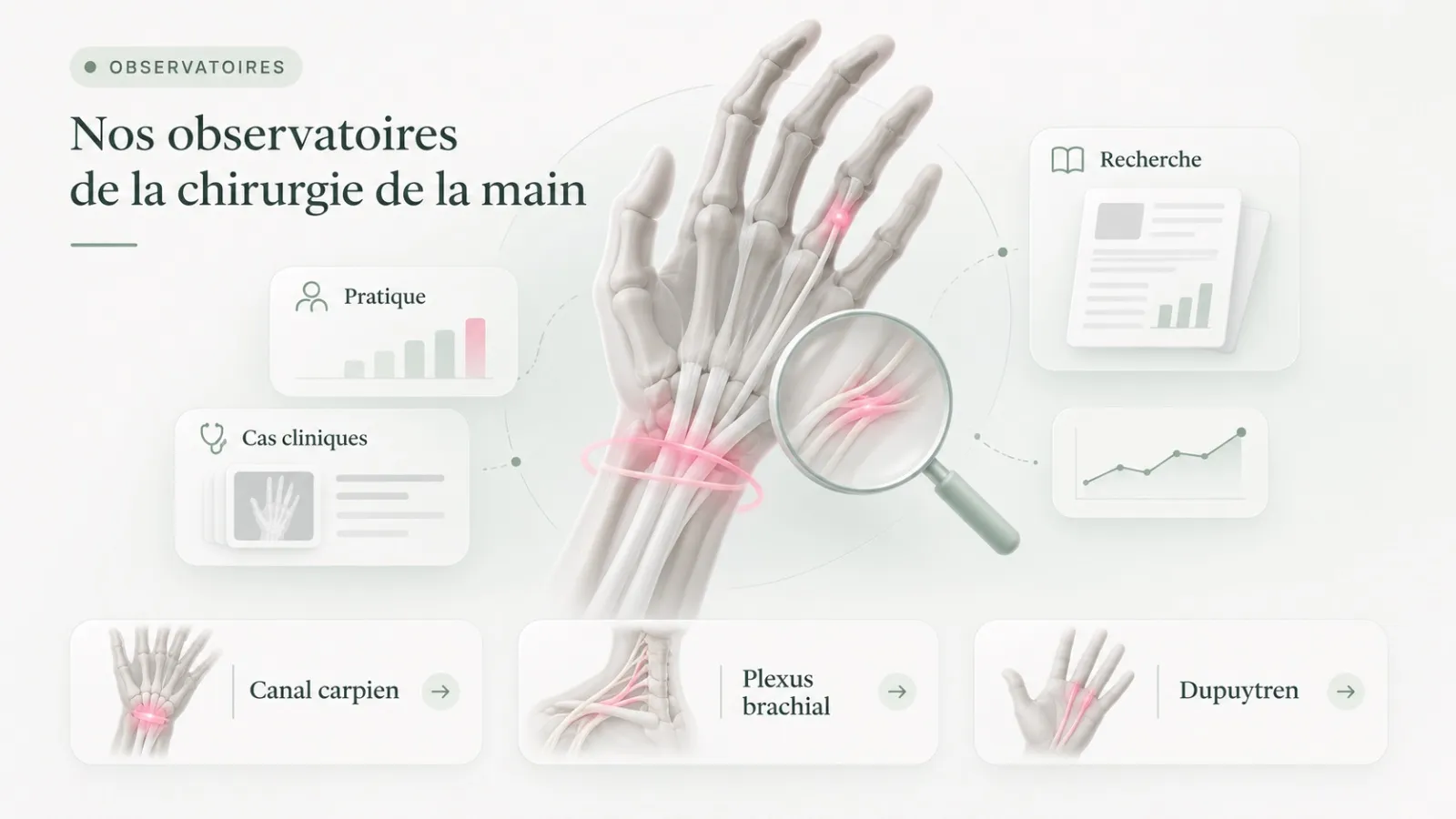
Three observatories
Carpal tunnel
The most common condition of the hand. Time to return to work, disappearance of tingling, recurrence, the role of EMG: what a series of more than 10,000 operations shows.
Brachial plexus
Brachial plexus injuries in adults: time to treatment, choice of nerve repairs, recovery of elbow and shoulder flexion.
Dupuytren's disease
Needle aponeurotomy, aponeurectomy: which technique for which stage, what gain in extension, what risk of recurrence depending on the patient's profile.
Each observatory follows the same outline: the figures from practice, the surgeon's insights, unusual cases, commented research and frequently asked questions.
Our commitments
The observatories comply with the French Code of Medical Ethics (articles R4127-1 et seq. of the French Public Health Code), which governs the information doctors give to the public.
- Information, not advertising The observatories inform patients in a fair, clear and appropriate way. They do not compare Dr Teboul with his colleagues and promise no results.
- Medical confidentiality Data are aggregated and anonymised. No patient can be identified from the published figures.
- Consented clinical cases Each case is published with the patient's written consent. Non-essential details (age, occupation) may be changed.
- Observations, not a scientific study This is a routine-practice series, without a study protocol or control group. The figures describe a population of patients and do not predict an individual result.
- Not a substitute for a consultation Only a clinical examination can establish a diagnosis and choose a treatment suited to your situation.
- Independence Comments on studies reflect Dr Teboul's opinion. Any conflicts of interest are declared on the French public database Transparence Santé.
See Dr Teboul
Dr Frédéric Teboul's practice92 boulevard de Courcelles, 75017 Paris Book an appointment