
A finger that catches in the morning. A thumb you have to straighten with your other hand. A dull ache in the palm, right at the base of the finger, that comes back every time you grip something.
If you are reading this, you are probably trying to find out two things: is it serious, and do you need surgery. This article answers both, drawing solely on published data, and distinguishing what is established from what is not.
What exactly is trigger finger?
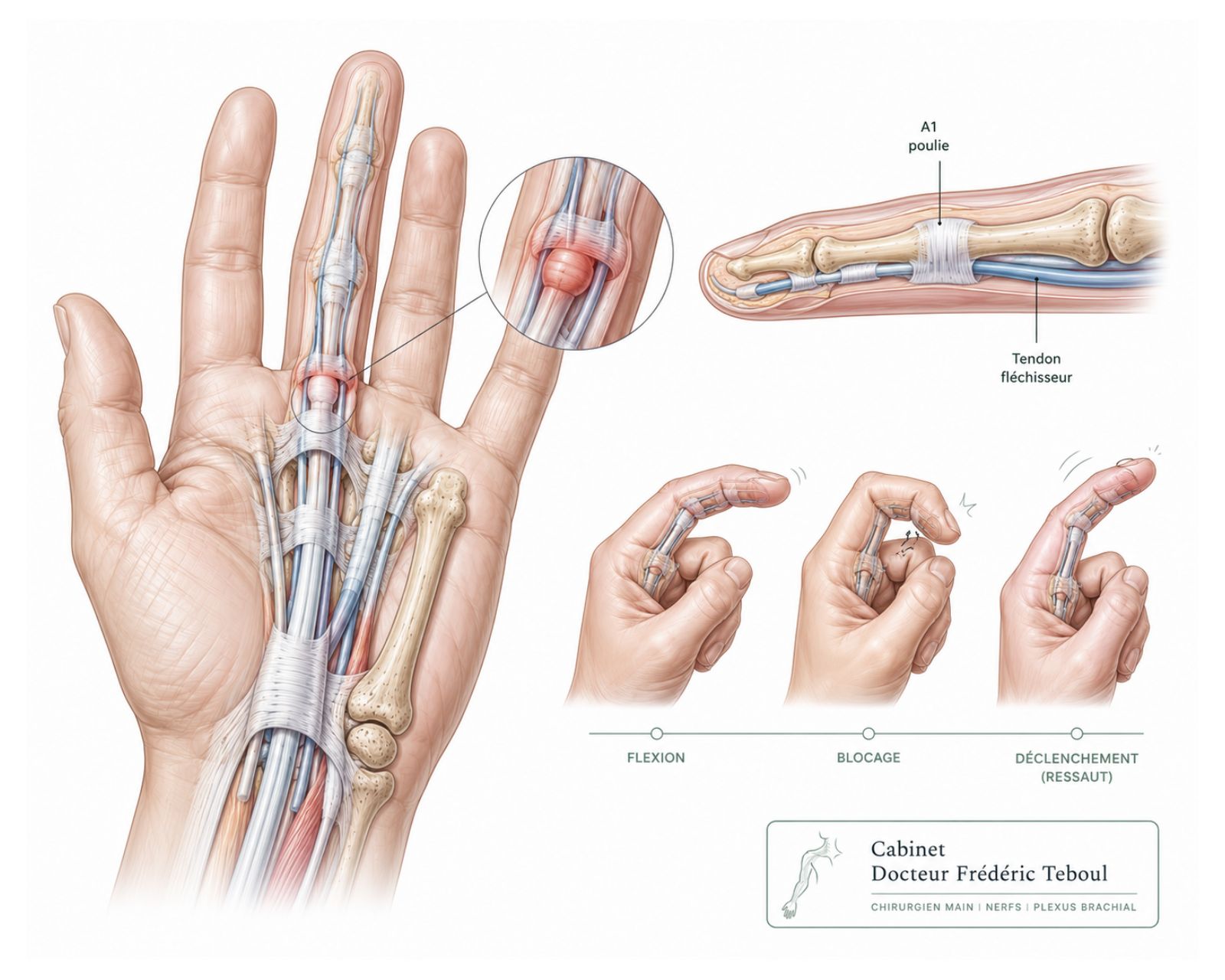
Your flexor tendons glide through a sheath, held against the bone by a series of fibrous rings called pulleys, numbered A1 to A5. Without them, the tendon would lift away from the bone with each bend, like a bowstring.
The A1 pulley is the first of these. It sits at the base of the finger, in the palm, over the head of the metacarpal. It is almost always the one involved.
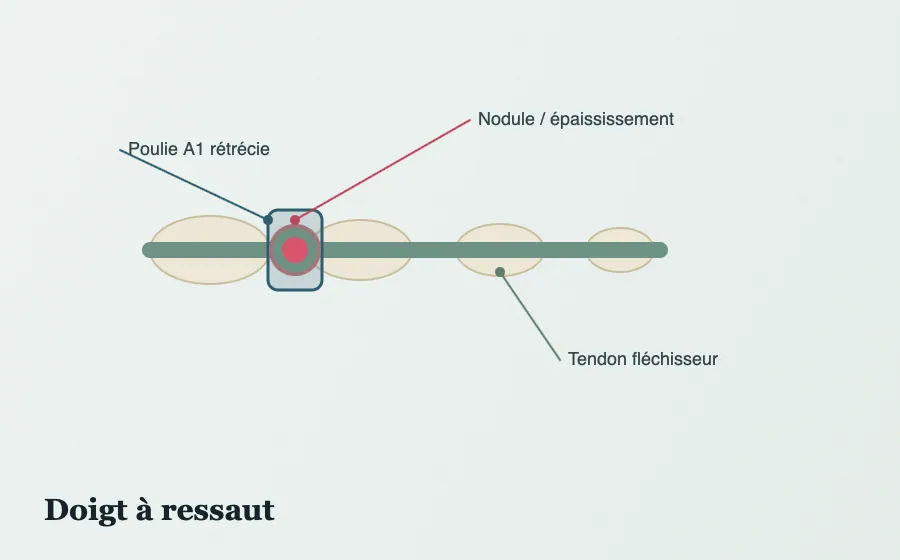
The mechanism is simple: the pulley thickens, the tendon thickens too and often develops a small nodule. At some point, the nodule can no longer pass freely beneath the pulley. The finger bends normally, but when you try to straighten it, the nodule catches. It eventually clears the obstacle with a sudden snap — that is the triggering.
It is not tendinitis
Trigger finger is still often called "stenosing tenosynovitis." The term is misleading. Analyses of tissue removed during surgery show no acute inflammation, but rather degeneration: the collagen becomes disorganized, the matrix remodels, the cells change in nature.
This distinction is not academic. It explains why rest and oral anti-inflammatory drugs are often disappointing: there is not much to "bring down." The problem is structural, mechanical.
Who is affected?
The lifetime prevalence of trigger finger is estimated at around 2%. Hansen 2017 So it is a common condition, though not a trivial one.
Situations that increase the risk:
Diabetes, both type 1 and type 2
This is the best-identified factor. The condition more often involves several fingers, sometimes on both hands, and responds less well to injections.
Inflammatory or infiltrative diseases
Rheumatoid arthritis, gout, amyloidosis.
Age
Its frequency increases after age 50.
Female sex
The condition is more common in women.
Prolonged, repeated gripping
Many patients report this link. It remains debated in the literature and is not established as a cause-and-effect relationship.
The fingers most often affected are the ring finger and the thumb, but any finger can be involved, and several can be affected at the same time.
Trigger thumb in infants and young children is a separate entity, with its own course and its own indications. It does not fall within what is described here and will be the subject of a separate article.
How it shows up, and what stage are you at?
The condition usually progresses in three phases.
Pain alone
It is felt in the palm, at the base of the finger, on the palmar side. It flares up when you grip an object, turn a key, or open a jar. A tender spot can sometimes be felt there.
Triggering
The finger catches on extension, then releases suddenly, sometimes with an audible snap. Symptoms are typically more pronounced on waking, easing gradually over the course of the day.
Locking
The finger stays bent and you have to straighten it with your other hand. At the next stage, it no longer straightens at all.
This progression corresponds to the Green classification, used in most clinical studies.
What should prompt you to see a doctor without delay
—A finger locked in flexion that you can no longer straighten, even with your other hand.
—Stiffness developing in the middle joint of the finger, independently of the triggering.
—Rapid worsening, or several fingers affected at the same time.
These situations are not life-threatening emergencies. But the longer a locked finger persists, the greater the risk of retaining residual stiffness even after the triggering itself has been treated effectively.
Diagnosis
It is above all clinical. A hand surgeon makes the diagnosis by examining you: palpating the tender spot over the A1 pulley, checking for triggering on flexion and extension, measuring range of motion, and looking for commonly associated conditions — carpal tunnel syndrome, Dupuytren's disease, osteoarthritis.
Ultrasound allows the thickening of the tendon and pulley, the nodular appearance, and any fluid in the sheath to be seen directly. It confirms the diagnosis in atypical cases and can guide certain procedures.
MRI is almost never needed. It is reserved for situations where something else is suspected: a tumor, a cyst, a complex lesion.
Which treatments, and in what order?
A common misconception circulates: that you necessarily have to climb a staircase — first the splint, then the injection, then surgery as a last resort.
That is not what the leading European consensus says. Convened in 2014 using a Delphi method, a panel of 35 experts — hand surgeons, hand therapists, and rehabilitation physicians appointed by their national federations — endorsed the splint, the corticosteroid injection, the combination of the two, and surgery as four equally valid options. The criteria identified for choosing between them are severity, how long the condition has been present, and treatments already tried. HANDGUIDE 2014
In other words: it is not a staircase, it is a decision tree. A finger that has been locked for a year does not warrant losing six months in a splint.
Note: this consensus is a 2014 expert opinion, not a recommendation based on a high level of evidence. The authors themselves point out that it will need to be reassessed as data accumulate.
Comparison of the options for treating trigger finger
What the injection does — and does not do
This is where the information available online is at its vaguest.
The Cochrane review on injections is based on only two trials and rates the level of evidence as low. Its estimate: about 37 patients out of 100 benefit from the corticosteroid plus local anesthetic combination, versus 17 out of 100 with the anesthetic alone. Cochrane 2009
A randomized trial also reported 57% cure after one injection, a rate rising to 86% when a second injection was given. Sato 2012
The injection is therefore neither useless nor miraculous: it is a treatment that is often effective, frequently temporary.
An important point about the word "success." In these studies, success means a finger that moves normally, or normally with some residual discomfort. That is not the same as "like before."
Surgery: what you need to know before deciding
Two techniques, one and the same goal
The procedure consists of cutting the A1 pulley to free the tendon's passage. It can be done through a small incision in the palm, under direct vision, or percutaneously, without opening.
The data comparing the two approaches are consistent and nuanced:
A meta-analysis of 7 randomized trials and 676 patients found no difference between the percutaneous and open approaches, either in the failure rate or in complications.
A larger meta-analysis — 14 randomized trials, 996 patients — found in favor of the percutaneous approach better functional scores in the short and medium term, less use of pain medication, and an earlier return to work by about 13 days on average.
A recent randomized trial of 146 patients provides the counterpoint: functional results equivalent at one year, grip strength even better after ultrasound-guided percutaneous release — and yet four repeat operations in this group (incomplete release, recurrent tenosynovitis, tendon rupture, neurovascular injury) versus none after the open approach.
Conclusion: percutaneous surgery allows faster recovery but carries a specific risk of incomplete release and injury to the neighboring structures. The choice is an indication set by the surgeon, not a matter of principled preference.
An important nuance we wish to add
Ultrasound guidance is not equally valuable depending on the procedure:
For percutaneous release, it allows the pulley, the tendon, and the nerves and vessels to be seen, and therefore the path of the instrument to be controlled.
For the injection, on the other hand, a systematic review of randomized trials concludes that the technique — ultrasound-guided or blind, inside or outside the sheath — does not significantly affect the results.
Presenting ultrasound as improving everything would be inaccurate. It changes the surgical procedure, not the effectiveness of the injection.
The risks, without downplaying them
This is the part that many websites gloss over. It deserves to be read carefully.
A prospective cohort study of 1,879 patients who underwent A1 pulley release reports complications in 17.1% of them. Koopman 2022
This figure seems high. It calls for an explanation.
The authors deliberately adopted a very broad definition, including not only objective events (infection, nerve injury) but also everything the patient reports themselves: stiffness, persistent pain, scar discomfort. They also point out that the rates published in the literature range from 0% to 43% depending on the definition used.
In detail:
Most complications are minor: use of rehabilitation or pain medication in 7% of cases, antibiotics in a smaller proportion.
2% of patients required a repeat operation.
In the Danish trial, complications after open surgery were more severe than after injection: three superficial infections and one iatrogenic nerve injury out of 81 patients operated on.
On the injection side, the reported adverse effects are a painful reaction after the injection, fat necrosis at the puncture site, local skin depigmentation or atrophy, and a transient rise in blood sugar in diabetic patients.
A waiting period to respect between injection and surgery
A point rarely mentioned, yet directly useful: several studies show that a corticosteroid injection given within the 90 days before surgery markedly increases the risk of deep postoperative infection.
If you have been injected recently and surgery is being considered, mention it: the date of your injection is part of the decision.
After the procedure
Postoperative care of a treated trigger finger, regardless of the technique, requires immediate mobilization of the operated finger, for some patients rehabilitation from the first postoperative day and the wearing of a dynamic extension splint for the proximal interphalangeal joint to prevent residual flexion contracture, and local wound care by a nurse for about ten days.
The patient is usually seen again in the months following the procedure. The length of time off work will not be tied to the technique used but to the patient's occupation.
The only usable published figure in the meantime: return to work is on average about 13 days earlier after percutaneous release than after the open approach. That is a difference between two techniques, not an absolute duration.
What happens if you do nothing?
Some mild forms improve simply by adapting how you use the hand. This is not the rule, particularly in the presence of diabetes.
The risks of waiting are persistent pain, gradual loss of mobility, and above all the development of finger stiffness that can persist after the triggering itself has been treated.
Frequently asked questions
Glossary
A fibrous ring at the base of the finger, in the palm, that holds the flexor tendon against the bone.
The cord that transmits the force of the forearm muscle to the finger to bend it.
The former name for trigger finger, now disputed because the mechanism is more degenerative than inflammatory.
Cutting the pulley without opening the palm, through a puncture point.
Carrying out a procedure under real-time ultrasound control.
References
Hansen RL, Søndergaard M, Lange J. Open surgery versus ultrasound-guided corticosteroid injection for trigger finger: a randomized controlled trial with 1-year follow-up. J Hand Surg Am. 2017;42(5):359-366. PMID 28341069
Huisstede BMA, Hoogvliet P, Coert JH, Fridén J; European HANDGUIDE Group. Multidisciplinary consensus guideline for managing trigger finger. Phys Ther. 2014;94(10):1421-1433. PMID 24810861
Peters-Veluthamaningal C, van der Windt DAWM, Winters JC, Meyboom-de Jong B. Corticosteroid injection for trigger finger in adults. Cochrane Database Syst Rev. 2009;(1):CD005617. PMID 19160256
Koopman JE, et al. Complications and functional outcomes following trigger finger release: a cohort study of 1879 patients. Plast Reconstr Surg. 2022. PMID 35994343
Koopman JE, Zweedijk BE, Hundepool CA, et al. Prevalence and risk factors for postoperative complications following open A1 pulley release. J Hand Surg Am. 2022;47(9):823-833. PMID 35718583
Percutaneous release, open surgery, or corticosteroid injection, which is the best treatment method for trigger digits? Clin Orthop Relat Res. PMID 23208122
Sato ES, Gomes dos Santos JB, Belloti JC, Albertoni WM, Faloppa F. Treatment of trigger finger: randomized clinical trial. Rheumatology (Oxford). 2012;51(1):93-99
Fiorini HJ, et al. Surgery for trigger finger. Cochrane Database Syst Rev. 2018;2:CD009860. PMID 29460276
Casey JC, Gil JA, et al. Open versus percutaneous fixation of trigger finger: meta-analysis. J Hand Surg Am. 2024
Meta-analysis of 14 trials / 996 patients, percutaneous vs open, 2026
Randomized trial of 146 patients, ultrasound-guided percutaneous release vs open approach
Systematic review, JPRAS 2025, injection techniques
Matzon et al., preoperative injection and infection risk
Page expanded, reviewed, and approved by Dr Frédéric Teboul, surgeon of the hand, the brachial plexus, and the peripheral nerves.
Last updated: August 20, 2026
Disclaimer. This article is for informational purposes. It does not replace a medical consultation. Only a clinical examination can establish a diagnosis and select a treatment suited to your situation.
Author of this publication
Every piece of content is signed by its author and reviewed before publication.
 Author
Dr Frédéric Teboul
Hand surgeon — specialist in the brachial plexus and peripheral nerves
Author
Dr Frédéric Teboul
Hand surgeon — specialist in the brachial plexus and peripheral nerves