
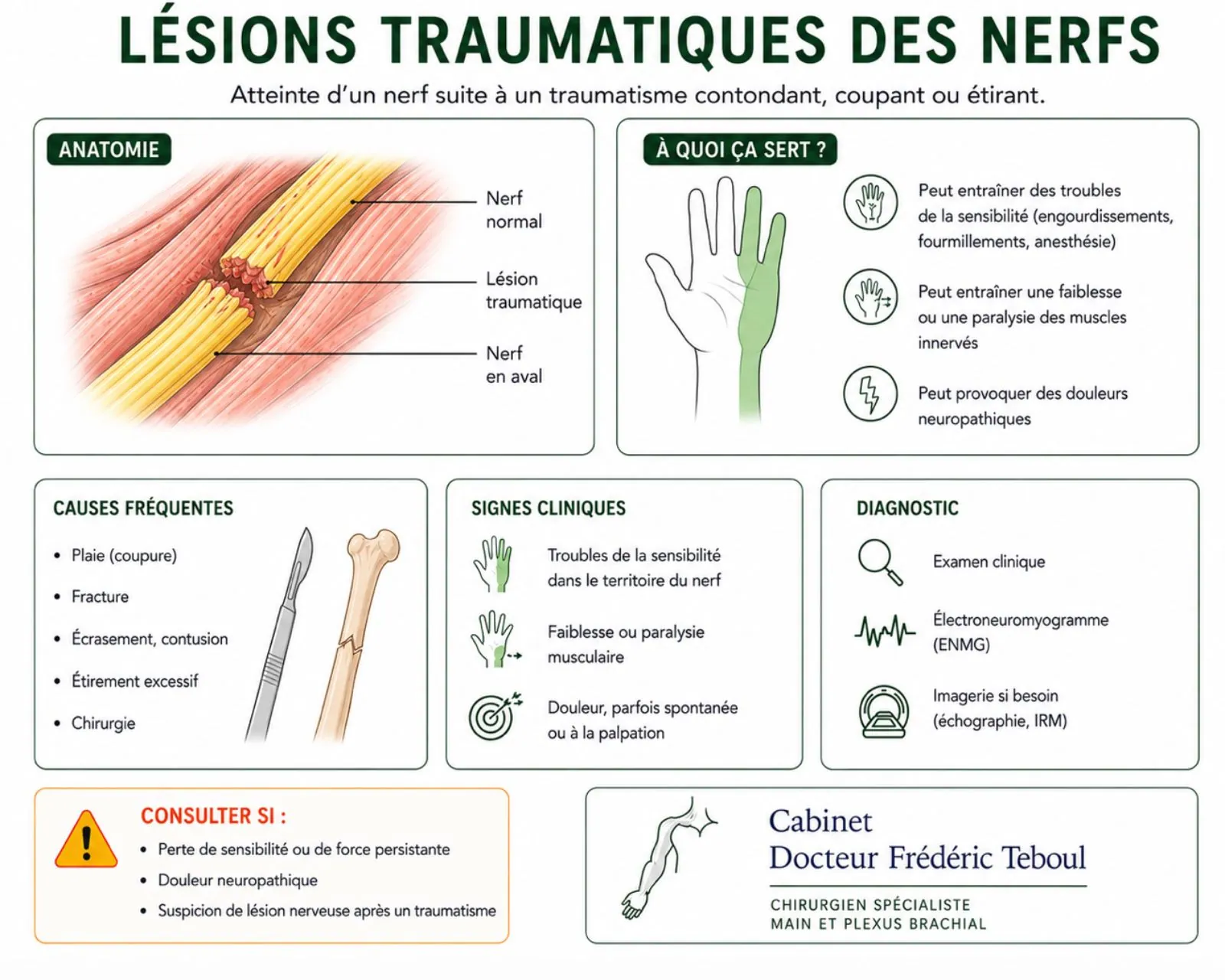
A deep cut from a knife or glass, and suddenly part of the hand feels nothing. Or a violent accident after which a finger or an area of the arm stays numb or weak. A nerve has been injured — and the question that immediately arises is: will it recover, and is surgery needed?
This article explains how a nerve gets injured, why not all injuries are alike, and above all why the nature of the injury — a clean cut or a closed injury — completely changes what should be done.
How a nerve gets injured
A nerve in the upper limb can be injured in several ways, which fall into two broad families depending on whether or not there is a wound in the skin:
Open injuries
A wound — knife, glass, sheet metal — severs the nerve, partly or completely. The nerve is cut cleanly or torn.
Closed injuries
With no wound in the skin, the nerve is crushed, stretched, or compressed — during a fracture, a dislocation, a blow, or prolonged pressure. The nerve often stays in continuity, even when damaged. More rarely, it snaps like a rubber band under tension.
An injury can also appear later, some time after the accident: a nerve caught in a bony callus as it forms, in a scar, or compressed by a displacement. This is why monitoring is necessary even when everything seems fine at first.
A pitfall to avoid
A nerve can be completely cut after a wound, and yet the clinical examination can be normal. The old saying that any wound along the path of a nerve should be explored — as old as surgery itself — remains a good one.
These nerves injured by accident are the same ones whose compressions and palsies are described elsewhere on this site. See the article on upper limb palsies.
Three degrees of severity, three prognoses
Not all injuries are alike, and this is the most important point to understand. Three degrees are classically distinguished, from the mildest to the most severe — a distinction that governs the prognosis.
From a stunned nerve to a severed nerve
The nerve is stunned, but intact: conduction is blocked for a time, without the nerve being severed. Recovery is spontaneous and complete, over a few weeks to a few months. This is the most favorable form.
The fibers are interrupted, but the sheaths preserved: the fibers have to grow back, which is possible but slow — the intact sheaths serve as a guide. Recovery takes place over several months.
The nerve is severed: fibers and sheaths are both cut. Spontaneous recovery is impossible or very inadequate; surgical repair is necessary.
The whole point of the work-up is to place the injury on this scale, because it separates what will recover on its own from what must be operated on.
The distinction that governs urgency: cut, or crushed?
This is the practical heart of the article. What to do depends first on the nature of the injury.
A wound that has cut the nerve: repair, and fast
When a clean or ragged wound has severed a nerve — and especially if, after a cut, an area of the hand feels nothing or no longer moves — the nerve must be explored and repaired quickly. Any wound with a loss of sensation or strength should raise suspicion of a severed nerve and be explored.
The repair is done under a microscope: the two ends of the nerve are brought together and sutured, or, if a fragment is missing, it is replaced with a graft. The earlier the repair is done, on a clean nerve with good-quality ends, the better the chances of recovery — but never 100 %.
A closed injury: often, monitor first
When the nerve has been crushed or stretched without a wound — in a fracture, a dislocation, a contusion — the situation is different. The nerve most often stays in continuity, and a large proportion of these injuries recover spontaneously. So the rule is often to monitor, treating the cause (reducing a fracture, relieving a compression) and documenting the deficit.
The few-months rule
For a closed injury, monitoring is done clinically and with an electromyogram. If no sign of recovery appears after roughly 3 to 4 months, an injury that will not recover on its own is suspected, and surgical exploration is considered. Conversely, if recovery begins, it is allowed to continue without surgery.
A sign that tells the story of recovery: the advancing Tinel sign
There is a simple, telling sign for tracking a nerve's regrowth. By gently tapping along the path of the nerve, a small jolt, a tingling, can be triggered in the nerve's territory. This tender spot marks where the fibers' regrowth has reached.
A tingling that moves down toward the hand: a good sign
If, week after week, this tingling spot gradually moves toward the hand — toward the end of the limb — it means the nerve is growing back and progressing. This is an encouraging sign, evidence of regeneration under way.
Conversely, a spot that stays stuck in the same place week after week suggests regrowth that isn't happening — valuable information for deciding whether to operate. It is one of the markers that help track progress, alongside the clinical examination and the electromyogram.
Neuropathic pain: part of the injury
A nerve injury doesn't only cause weakness or numbness: it is often accompanied by a distinctive kind of pain — burning, electric shocks, unpleasant sensations at the slightest touch. This neuropathic pain is part of the injury and must be treated early and specifically, because it can persist and weigh heavily, even as motor recovery begins.
The work-up
The history and examination pinpoint the mechanism (cut, blow, fracture), map the deficit, and track it over time — a repeated examination is worth more than a single one.
It locates the injury, assesses its severity, and tracks recovery. It is not informative right away: it should be done at the earliest 4 weeks after the initial trauma.
Ultrasound and MRI explore the continuity of the nerve and look for compression by a hematoma, a scar, or a bone fragment. Bone imaging is essential when a fracture is involved.
The repair, when it is necessary
Depending on the injury, several microsurgical techniques are combined:
Bringing together and stitching the two ends of a cleanly cut nerve, without tension.
Filling a gap with a fragment of nerve taken from elsewhere, serving as a bridge for regrowth.
For short nerve gaps.
Connecting a functional donor nerve to the nerve to be reactivated, especially for high or complex injuries.
As with the plexus, the goal is not perfect recovery but the best useful function possible, and timing remains decisive: a muscle deprived of its nerve for too long recovers poorly.
The overview table
This table sums up the article: a wound that cuts is explored quickly; a closed injury is monitored first; and everywhere, time matters.
Rehabilitation and lasting effects
Several detailed cases, in specific settings, are presented in our knowledge center.
Frequently asked questions
Glossary
Damage to a nerve from an accident: a cut, crush, stretch, or compression.
An injury with a skin wound, which may sever the nerve; explored quickly.
Damage with no wound, the nerve often staying in continuity; monitored first.
Tingling triggered by tapping on the nerve; its movement toward the hand reflects regrowth.
Pain linked to the nerve injury — burning, shocks — to be treated early and specifically.
Microsurgical techniques for repairing a nerve according to the type and extent of the injury.
References
Peripheral Nerve Injury. StatPearls. 2026 — most closed injuries stay in continuity and are treated conservatively; in the absence of signs of reinnervation at 3-4 months, neurotmesis is suspected and exploration is warranted
Peripheral Nerve Injuries Treatment & Management. Medscape — any wound with loss of sensation or weakness must be explored; clean wounds are repaired by direct suture as soon as possible
Seddon classification (neurapraxia, axonotmesis, neurotmesis) — three degrees of severity that determine the prognosis
Peripheral Nerve Injury & Repair. Orthobullets — direct suture, graft, nerve transfer, or tendon transfer depending on the age of the injury, the degree, the quality of the nerve, and the mechanism
Tinel Sign (reviews 2021-2026) — a Tinel sign that advances distally reflects axonal regeneration; a Tinel sign that doesn't advance indicates interrupted regeneration
Medico-legal aspects of peripheral nerve injury. Bone & Joint. 2017 — neurapraxia recovers in 2 to 12 weeks; neurotmesis requires surgery, with recovery over 2 to 18 months; regrowth ~1 mm/day
Functional outcomes of nerve repair according to the delay and the nerve involved
Management of post-traumatic neuropathic pain of the upper limb
Reviewed and approved by Dr Frédéric Teboul, hand, brachial plexus, and peripheral nerve surgeon, member of the Académie Nationale de Chirurgie.
Last updated: 20 August 2026
Disclaimer. This article is for informational purposes. It does not replace a medical consultation. A wound accompanied by a loss of sensation or strength in the hand should be seen promptly: it may have cut a nerve.
Author of this publication
Every piece of content is signed by its author and reviewed before publication.
 Author
Dr Frédéric Teboul
Hand, brachial plexus, and peripheral nerve surgeon
Author
Dr Frédéric Teboul
Hand, brachial plexus, and peripheral nerve surgeon